Has mentored founders and leaders from






You have about 6,000 thoughts a day. How many of them can you switch off? Source: Tseng & Poppenk, Nature Communications, 2020 · Queen's University · ~6,200 thoughts a day
Some thoughts stay: they come back, insist, demand, and decide in your place. The decision postponed. The work redone. The sleepless night. The outburst you did not want. Each one has an origin: a part of your mind that decides without you noticing. That is what the mentoring works on, and proves.
Eight questions, two minutes. Then a 45-minute interview. We only start if it makes sense for both sides.
In order of frequency, from what shows up most in my sessions to what shows up least. It is not weakness or lack of discipline: it is your mind repeating patterns you never had a way to see.
You postpone, redo, get distracted, and even next to the people you love your head stays at work. Then come the stress, the anxiety and the insomnia. It has an origin, and it can be identified in 4 minutes.
You answer 24 everyday situations and receive, right away, a personal report: which mental patterns are deciding for you today, what each one costs in hours and results, and where to start. It is yours, as a PDF, whether or not you apply. The diagnosis is available in Portuguese for now; English speakers can apply directly.
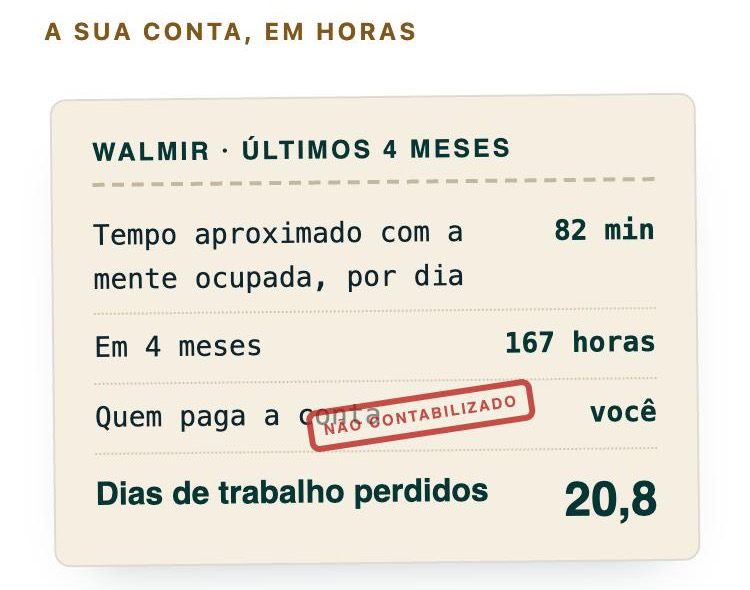
The statement of your lost hours, in the report you receive (example, in Portuguese).
Take the free diagnosis (in Portuguese)Free · 4 minutes · no commitment. If you read Portuguese, start here: the interview builds on your report.
Thoughts arrive uninvited, and between one decision and the next, they are the ones that speak loudest. Trying to silence them does not work: what is suppressed comes back stronger.
The way out is not to defeat your own mind. It is to take over its management: notice what shows up, name it, understand what each thought is trying to protect, and respond differently.
Manager of the relationship, not the thought police. That is what separates this work from "positive thinking", from meditation as anaesthesia and from any promise of total control.
Basis: 20–60% of waking time under intrusive thoughts (Harvard) · ~6,200 thoughts a day (Tseng & Poppenk, Nature Communications, 2020 · Queen's University)TCM, the Theory of Modular Consciousnesses, is the result of 30 years of practice and 8 of research. It is applied in four simple moves that you learn to make on your own. Nothing is improvised: it is the same path from the first meeting to the last.
Where the thought appeared and what it said. What you cannot see governs you.
Each pattern gets a name. We call it a Partner: it acts like a business partner who gives opinions without being asked. What has a name can be managed.
No thought is negative at its origin. Each one exists to protect something: a result, an image, a loss. The intention is good; the way gets in the way.
With the intention clear, an agreement is born: the same pattern starts working in your favour. Nobody gets fired. They get repositioned.
Assessment at the start, in the middle and at the end: the same measure, compared on a chart. Not a feeling of improvement: the before and after, in writing. The people who live and work with you can take part, if you want.

Less anxiety, inner pressure and procrastination. Your head switches off to sleep.

You decide faster and hold the decision. You finish what you start.

Fewer impulsive decisions and less rework. Fewer missed opportunities.

More presence at home and with the team. Less reacting on autopilot.

You wake up rested. Neck, shoulders and stomach give you a break.
TCM one-to-one, up to 4 months. Just you and me, from diagnosis to proof of change. One pattern at a time, starting with the one that weighs most.
On your own, you complete the assessment of the 24 patterns and the 12 areas of life. 20 minutes. I arrive with your map in hand.
We work on the pattern that costs you most today. It stops running on autopilot and starts answering to you: the turn. The first effect shows up in the same session.
What changed becomes routine: five minutes of logging a day sustain the change when nobody is watching.
The same assessment is repeated in the middle and at the end. If you choose the 360°, with the same people. The result is compared with the starting point, on a chart.
Live online meetings. Occasional in-person meetings: travel and accommodation at the mentee’s expense. The investment is presented in the interview.

I am a licensed psychologist (CRP 07/14365, Brazil), but this work is not psychotherapy: it is mental performance training. If your case calls for clinical care, I will tell you in the interview.
Entrepreneur · Specialist in mental performance and intrusive thoughts · Researcher · Creator of TCM

I played Andre Agassi, Pete Sampras and Michael Chang when we were all juniors. I was state, Brazilian and South American champion, and turned professional. The opponent across the net was rarely the problem. The problem showed up between one point and the next, as a sentence in my head, and I had no control over it at all.
I looked for the answer in psychology, in clinical hypnosis in the United States, in NLP with Tony Robbins and Richard Bandler, at the Milton Erickson Institute and in an MBA at FGV, where I later taught for six years. I spent fifteen years in Zen Buddhism and reached a conclusion against the current: meditation is palliative. It also silences the thoughts that build.
I went through two surgeries without anaesthesia, using self-hypnosis. It was the only way I had to measure, in my own body, how far control reaches over processes that supposedly cannot be controlled.
In 2018, on a StartSe immersion in Silicon Valley, I came back with one idea: work on insomnia. I gathered twenty people who could not sleep, and about seventy percent slept again. The shock: I had not used NLP, hypnosis, or anything I had spent twenty years learning.
Just as we were about to launch the training, I perforated my oesophagus. A seventy percent chance of dying. The doctors did not operate, and a recovery of six months to a year took two weeks. The team nicknamed me Highlander. It was the same discovery I had been testing with my students: we can have a closer relationship with the unconscious and use it to overcome challenges.
During a sabbatical year I reviewed every recording and understood: this was not a method, it was a new theory of how the mind works, TCM, the Theory of Modular Consciousnesses. Inside the mind there are intelligent consciousnesses, with desires and beliefs of their own, that communicate through the thoughts that arrive uninvited. They try to help; without management, they get in the way. Eight years of research later, the theory is now going through scientific validation.
For many years I was a partner in my family’s construction company in Porto Alegre, and recently made my definitive exit. It was not detachment. It was completion. I am the founder of BT Inova.
I am married, a father of three and a jiu-jitsu black belt. What I want is deliberately out of proportion: to help millions of people understand that the thought that gets in their way is not a defect, not an illness, and does not need to be silenced.
I work with a few people at a time, each one led by me from start to finish. The application takes two minutes. If it does not make sense, I will tell you.
Live online meetings. Occasional in-person meetings: travel and accommodation at the mentee’s expense.
Apply for a placeTwo minutes · no commitment
Prefer to talk first? WhatsApp →